What Is the Best Golf Simulator for Business Owners?
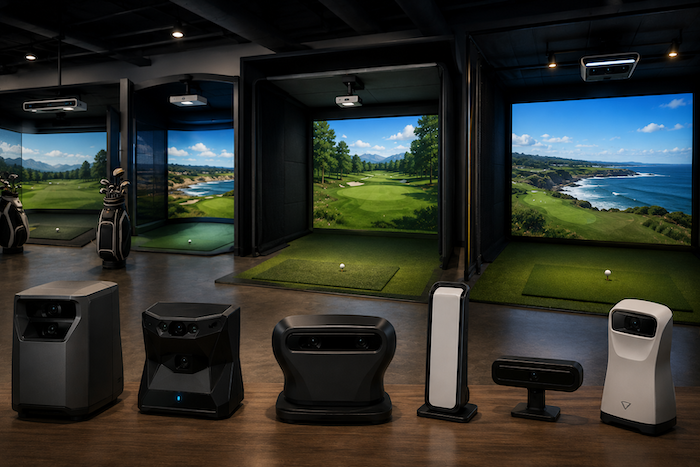
The best golf simulator for a business depends on your venue model. Golfzon leads for entertainment-first venues, TrackMan and Foresight dominate instruction and club fitting, Uneekor offers the strongest value for multi-bay buildouts, Full Swing fits multi-sport concepts, and Golf VX pairs its technology with a franchise model. There is no single winner, but there is a right answer for your specific business.
If you are planning to open an indoor golf facility, add simulator bays to an existing venue, or start your own golf simulator business from scratch, the system you choose is one of the biggest decisions you will make. It shapes your buildout costs, your space requirements, the customers you attract, and the price you can charge per hour.
In this guide, we compare the leading commercial golf simulator options by business model, break down the equipment that holds up under daily use, and cover the software, marketing, and operations that separate profitable venues from expensive hobbies. You do not need to be an expert in golf simulation technology to make a smart investment. Once you understand what actually matters for a commercial setting, the decision gets much easier.
What Makes a Commercial Golf Simulator the Best Choice?
The evaluation criteria for a commercial golf simulator are different from those of a hobbyist buying for a garage. A venue system runs eight to twelve hours a day, gets used by players of every skill level, and has to perform during your busiest Saturday just as reliably as a quiet Tuesday morning.
Accuracy That Holds Up Under Volume
Serious golfers compare launch monitors on data points like ball speed, spin rate, launch angle, carry distance, club path, and club head speed. Casual groups just want the shot on the screen to match the shot they hit.
The best commercial golf simulator systems deliver both. They provide accurate data for lessons and leagues while keeping the experience fun for parties and walk-ins. Serious golfers will notice accurate ball tracking immediately, and so will their friends when a mishit shows up honestly on the screen.
Tracking Technology That Fits Your Space
Camera-based (photometric) systems capture high speed images around the impact zone and generally work well in tighter bays. Radar-based (Doppler) systems track the full ball flight and typically need more room depth to read shots accurately.
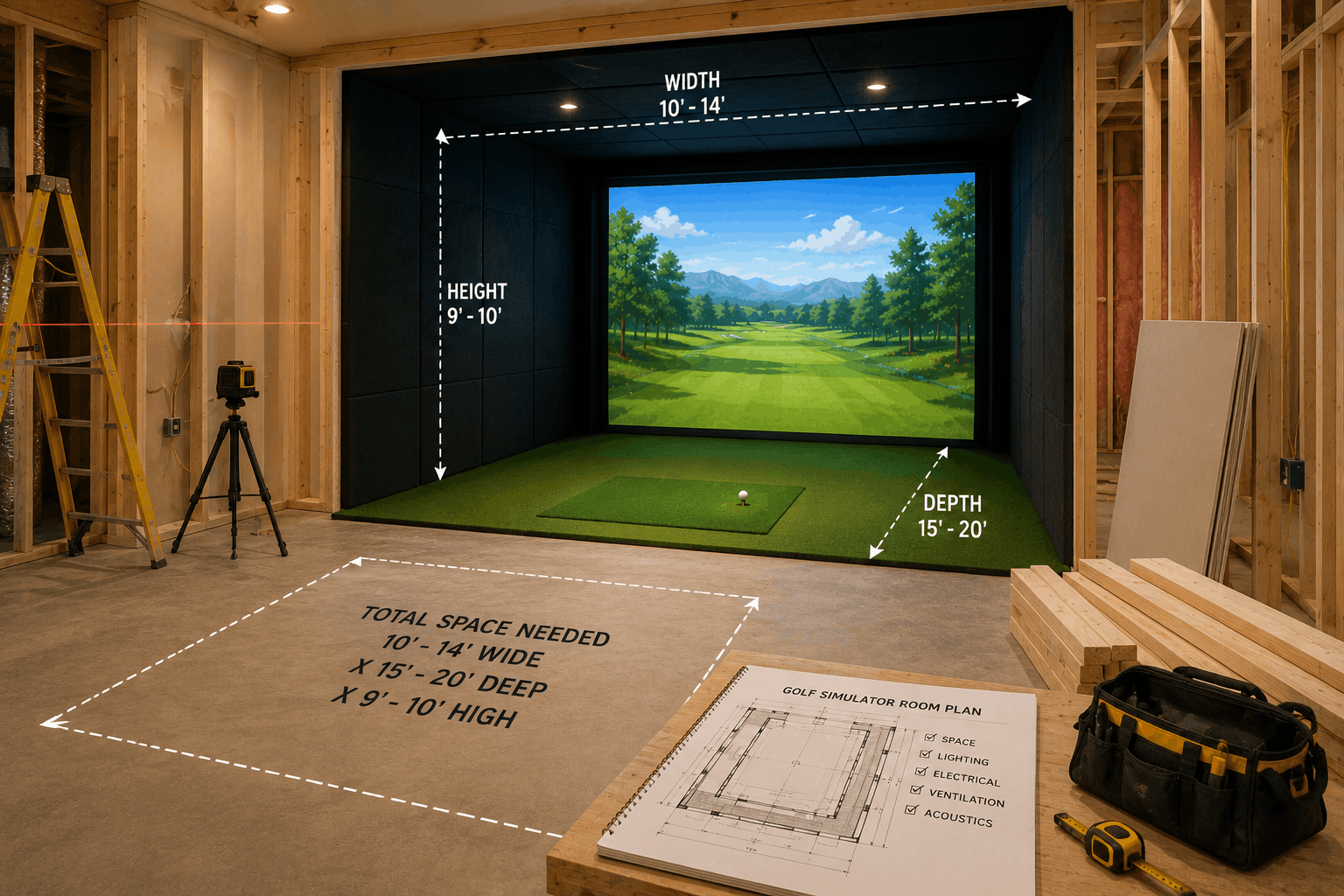
Your bay dimensions can rule systems in or out before price ever enters the conversation, and both approaches deliver reliable ball data when matched to the right room. Our guide to golf simulator space requirements breaks down the numbers by golf simulator setup type.
Durability and Support
Commercial setups take a beating that residential units never see. Ask every vendor about commercial warranties, on-site installation, staff training, and what happens when a sensor fails on a Friday night.
Response time matters more than spec sheets here. A dead bay on a weekend is lost revenue you never get back.
Total Cost Per Bay
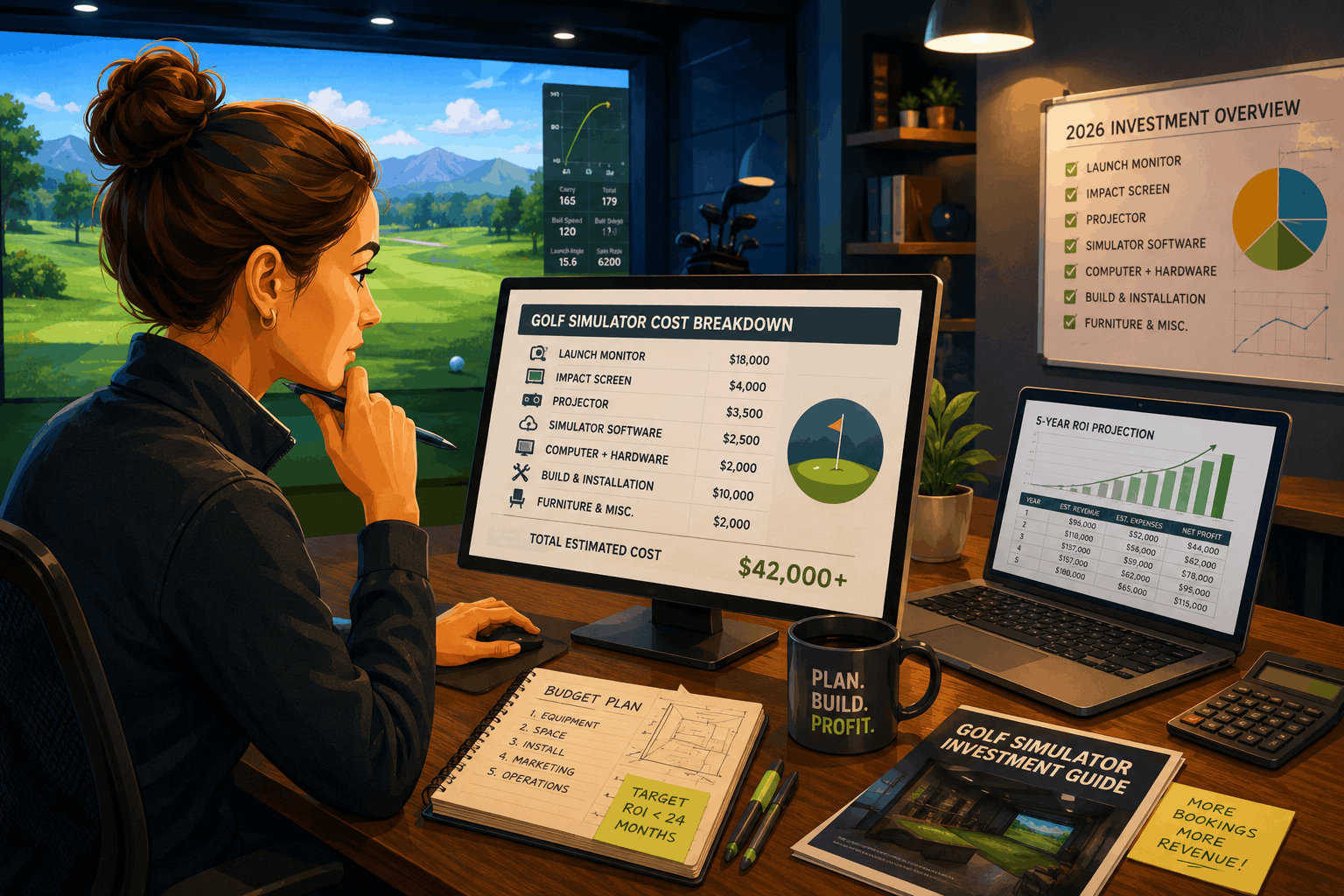
Commercial golf simulator packages commonly run from under $20,000 to $50,000 or more per bay once you include the launch monitor, enclosure, impact screen, projector, computer, hitting mat, and commercial software licensing. Entry level setups exist below that range, but they rarely hold up under commercial use.
Our breakdown of commercial golf simulator cost covers the full picture, including the line items most first-time operators miss.
The Best Commercial Golf Simulators by Business Model
Rather than crowning one system, it is more useful to match the leading platforms to the venue types they serve best. These six come up in nearly every commercial conversation, and each wins for a different kind of golf business.
Golfzon TwoVision NX: Best for Entertainment-First Venues
Golfzon powers more commercial venues worldwide than any other brand and has been named the number one golf simulator by Golf Digest four years in a row. The TwoVision NX is its flagship: a moving swing plate that tilts to simulate uphill, downhill, and sidehill lies, an auto-tee system, overhead sensors, and Unreal Engine 5 graphics that deliver genuinely immersive visuals.
Its large course library of more than 200 licensed golf course options includes St. Andrews and Pebble Beach, creating a realistic experience players compare to being on the course. The moving swing plate is the feature no competitor matches, and the immersive experience it creates is the kind of thing customers tell their friends about. If your revenue model depends on repeat visits, Golfzon is the benchmark.
TrackMan iO: Best for Instruction and Premium Clientele
TrackMan is the launch monitor most trusted by tour coaches, club fitters, and teaching professionals, and that reputation is a marketing asset in its own right. Players book sessions specifically because they want TrackMan data.
The iO is the indoor, ceiling-mounted version, combining dual radar with high speed cameras and delivering shot data almost instantly. TrackMan's commercial software also integrates booking and payment tools, though many venues still prefer dedicated booking software that works across every system in the building. For teaching studios, country clubs, and venues courting low-handicap players, TrackMan supports premium session pricing that other brands struggle to command.
Foresight GCQuad: Best for Coaching and Club Fitting
The GCQuad is widely considered the gold standard among camera-based portable launch monitors and is used by top coaches and tour players. Running Foresight's FSX Play software, it excels in one-on-one instruction and club fitting, where its detailed club data matters most.
As a portable unit it is less common as the anchor of a multi-bay entertainment floor. But for a lesson-driven studio, a fitting bay inside a larger venue, or a pro who wants to run lessons on tour-grade data, it is hard to beat.
Uneekor EYE XO2: Best Value for Multiple Bays
Uneekor's EYE XO2 delivers overhead camera tracking that competes with the premium systems at a noticeably lower per-bay cost, with commercial builds commonly estimated in the range of $18,000 to $25,000 per bay including enclosure, projector, computer, and mat.
Its three overhead cameras read accurate ball data and club data without marked balls or stickers, the overhead mount keeps the floor clear, and switching between right- and left-handed players is seamless. For operators building multiple bays, the per-bay savings compound quickly, which is why Uneekor comes up so often in multi-bay planning.
Full Swing KIT and Commercial Packages: Best for Multi-Sport Entertainment
Full Swing carries PGA Tour branding and offers a multi-sport library covering soccer, baseball, and other games alongside golf. For sports bars and entertainment venues where food, drinks, and private events drive revenue, the multi-sport content fills off-peak hours that golf-only systems leave empty.
Accuracy-focused players and teaching pros tend to prefer TrackMan or Foresight for serious work, so Full Swing fits best where entertainment, not instruction, is the core product.
Golf VX: Best for Franchise-Model Operators
Golf VX pairs Kakao VX simulation technology with a venue and franchise model, which makes it a different kind of option from the hardware-only brands. Its systems feature a moving swing plate with multiple hitting surfaces, an auto-tee system, and AI-driven swing analysis with instant feedback on club path, face angle, and ball speed. Its newer Quantum platform adds upgraded graphics and training tools.
For an entrepreneur who wants a commercial indoor golf simulator concept with buildout support and an established playbook rather than assembling a venue from separate vendors, Golf VX is worth a look. As with any franchise, weigh the fees and brand requirements against the value of the support.
The Quick Answer by Venue Type
Entertainment venue built on repeat visits: Golfzon. Teaching academy or premium clientele: TrackMan iO. Lesson and fitting studio: Foresight GCQuad. Multi-bay facility watching per-bay costs: Uneekor EYE XO2. Sports bar or multi-attraction venue: Full Swing. Franchise-style launch with buildout support: Golf VX.
Commercial Equipment That Protects the Investment
The launch monitor gets the attention, but the equipment around it determines whether your bays survive year one. Indoor golf simulators in commercial facilities live hard lives, worn gear drags down the simulator experience fast, and commercial grade golf simulator components cost more than their residential equivalents for a reason.
Heavy-Duty Impact Screens
A commercial impact screen absorbs thousands of golf ball strikes annually, often tens of thousands in a busy facility. Investing in premium, heavy-duty impact screens is essential for commercial setups. Thin residential screens develop wear marks and dead spots quickly under that volume, and a degraded screen undermines the truly immersive experience customers are paying for. Some premium venues go a step further with a curved screen for a wraparound view.
Durable Hitting Mats
Commercial facilities need hitting mats built for constant play. A quality commercial mat has a realistic feel underfoot, protects players' joints, and keeps ball reaction consistent, and a generous hitting area handles players of every stance. A worn hitting area makes a bay look tired after six months.
Ceiling-Mounted Units
Ceiling-mounted launch monitors are the recommended configuration for commercial setups. Overhead mounting keeps expensive equipment out of the path of clubs and mishits, enables seamless switching between right and left handed golfers, and keeps the floor clear for groups moving in and out of the bay.
Calibration and Software Updates
Regular calibration and software updates are important for commercial setups to avoid downtime. Build both into your maintenance schedule rather than waiting for accurate data to drift or a bug to surface mid-league night. Most vendors publish maintenance intervals; treat them as minimums in a high-traffic venue.
Commercial Software Licensing
Simulator software sold for home use typically does not permit paid access. Your software should include a commercial license so you can legally charge clients, and most platforms price commercial licensing per bay or per location. Confirm every title in your lineup is cleared for commercial use before launch, not after.
The Software Layer Matters as Much as the Hardware
A golf simulator is only as good as the simulator software behind it. The hardware captures the numbers, but the software turns them into the golf experience your customers pay for: the virtual golf courses they play, the leagues they join, and the practice tools that help them improve their golf game, from full swings to the short game.
The visual side matters too. High resolution graphics and a bright projector enhance the experience as much as the tracking hardware, and realistic graphics keep long sessions engaging. On the operations side, some platforms include a clubhouse dashboard so staff can monitor every bay at a glance.
Large course library options, multiplayer support, licensing terms, and league software features vary widely between platforms. We cover that side of the decision in depth in our guide to the what to look for in golf simulator booking software, which pairs with this article: this one covers the hardware, that one covers the software running on it.
What Makes Golf Simulator Businesses Profitable?
Accuracy gets the attention, but profitability depends on utilization. The golf simulator business model rewards the operator who keeps bays full, and one full bay booked consistently is more valuable than three empty bays with better spec sheets.
Recurring Programs Beat Walk-In Traffic
The venues that generate revenue most reliably share a pattern: they run leagues, host tournaments, sell memberships, offer coaching programs, and book private events and corporate outings. Hourly play and walk-ins are the baseline, but these programs create year round revenue and fill the weekday hours that walk-in traffic never covers.
Unlike outdoor play, golf simulation is not weather-dependent, which is exactly why country clubs and golf courses add indoor golf simulators to keep members engaged through the off-season. Winter is peak season for an indoor golf business, and recurring programs are how you capture it.
Utilization Is the Real Metric
A commercial golf simulator that performs consistently through peak hours generates far more value than one with marginally better specs and frequent downtime. When you evaluate premium systems, ask not only "how accurate is it?" but "how will it help keep golfers engaged and coming back?"
League support, multiplayer features, and event tooling are business features, not extras, because a golf simulator business lives and dies on how many hours each bay sells. This is also where operations software enters the picture, because the best hardware in the industry still loses money if bays sit empty and staff spend shifts untangling the schedule. If you are still mapping out the business model, our guide to starting a profitable golf simulator business walks through the full operating plan.
How to Market a Golf Simulator Business
The best commercial golf simulator in the world cannot fill bays on its own. Local visibility drives most bookings for indoor golf facilities, and a few marketing fundamentals do most of the work.
Claim and Optimize Your Google Business Profile
A complete Google Business Profile is crucial for local visibility. Most customers find an indoor golf facility by searching for indoor golf nearby, and your profile with hours, photos, and booking links is often the first impression anyone gets of your indoor golf business. For a new golf simulator business, it is the highest-leverage marketing task on the list.
Showcase the Atmosphere on Social Media
Social media should showcase the lively atmosphere of your indoor golf business, not just the technology. Short videos of league nights, celebrations after a closest-to-the-pin contest, and groups enjoying the immersive environment sell the golf experience better than spec sheets ever will.
Collect Customer Reviews
Customer reviews strengthen local search visibility and give hesitant first-timers social proof. Ask for reviews at the moment of a great experience, such as right after a league win or a well-run birthday party, and respond to every one.
Use Email and SMS to Fill the Calendar
Email and SMS can effectively promote events and offers to people who have already visited. Announcing a new league season, an open house, or an off-peak discount to your existing list is the cheapest booking you will ever generate.
How Sports Carnival Turns Good Hardware Into a Good Business
Sports Carnival is booking and operations software built for golf simulator venues and other experience-based businesses. It keeps bookings, memberships, leagues, payments, and customer records in one platform, so operators spend their time growing the venue instead of reconciling spreadsheets.
For a golf simulator business specifically, that means online booking that maximizes bay utilization, automated reminders that cut no-shows, membership management that keeps members engaged between visits, and league and tournament software solutions that turn one-time visitors into weekly regulars. It works as the clubhouse dashboard for the whole venue, and whichever hardware you choose, the operations layer determines whether those bays stay full.
What Golf Facility Owners Say: 9Yards Golf
9Yards Golf, a commercial simulator facility and Sports Carnival customer, hit the growing pains every successful golf simulator business eventually faces. As demand grew, manual scheduling stopped keeping up. Peak hours became a guessing game, double bookings crept in, and league management meant updating fixtures across multiple files, with every small change triggering a chain of follow-up messages between staff and players.
After moving to Sports Carnival, bookings were centralized, scheduling conflicts stopped, and bay utilization became consistent. Check-ins got faster and members could see exactly when and where they were booked. The biggest change came on the events side: league fixtures, tournament brackets, and score tracking moved into one organized system, and even large events with hundreds of teams and thousands of matches ran without interruption.
The lesson for anyone comparing systems: 9Yards did not grow because of a hardware upgrade. It grew because the operational side finally matched the quality of the experience in the bay.
Conclusion
There is no single best golf simulator, but there is a best one for your golf business. Entertainment venues gravitate to Golfzon, instruction businesses to TrackMan and Foresight, multi-bay operators to Uneekor, multi-sport concepts to Full Swing, and franchise-minded entrepreneurs to Golf VX. Confirm the golf simulation technology fits your space, budget the full per-bay cost rather than just the launch monitor, and weigh how each platform supports leagues, memberships, and events, because that is where the recurring revenue lives.
A commercial golf simulator is more than just golf equipment. It is the anchor of a hospitality business, and the venues that win treat the customer experience, the marketing, and the operations as seriously as the tracking specs.
Then make sure the operations side can keep up. A great simulator fills a bay once. Smooth booking, organized scheduling, and well-run leagues fill it every week. That is the part Sports Carnival handles, so the investment you make in commercial setups turns into a business that runs calmly, even on your busiest weekend.
FAQs
Q1. What is the best golf simulator for business owners?
It depends on your venue model. Golfzon leads for entertainment venues, TrackMan iO and Foresight GCQuad for instruction and fitting, Uneekor EYE XO2 for multi-bay value, Full Swing for multi-sport concepts, and Golf VX for franchise-style launches.
Q2. What is the most accurate golf simulation technology?
Radar systems, camera systems, and hybrids that combine both all deliver tour-level accuracy when properly installed. Camera-based units generally suit tighter bays, while radar needs more room depth to track the full ball flight.
Q3. How much does a commercial golf simulator cost per bay?
Commercial golf simulator packages commonly range from under $20,000 to $50,000 or more per bay, including the launch monitor, enclosure, screen, projector, computer, mat, and commercial software licensing. Installation and buildout are usually additional.
Q4. How much space does a commercial golf simulator bay need?
A 10 foot ceiling is a common starting height for simulators. Treat 10 to 12 feet of width and 15 feet of depth as the minimum room size, with a comfortable full-swing commercial bay closer to 12 feet wide and 15 to 18 feet deep. Radar-based systems need the most depth, so make sure players have enough space for a full swing and check the specific system's requirements before committing to a floor plan.
Q5. Do golf simulator brands matter to customers?
Yes. Serious golfers book sessions specifically for TrackMan or Foresight data, while entertainment customers respond to features like Golfzon's moving swing plate. The brand on the wall shapes who walks in the door.
Q6. What should a commercial golf simulator package include?
A complete bay includes the launch monitor, enclosure, impact screen, projector, computer, hitting mat, and a commercial software license that permits charging customers. Confirm commercial warranty terms and installation support, since residential packages often exclude both.
Q7. Can a golf simulator work for country clubs and golf courses?
Yes. Country clubs and golf courses add indoor golf simulators to give members a place to practice, play a quick golf game, and take lessons year-round, keeping the facility productive when outdoor play is not an option.
Q8. How do golf simulator businesses generate revenue year-round?
Leagues, tournaments, memberships, coaching, and private events fill off-peak hours and turn one-time visitors into weekly regulars. Indoor golf peaks in winter, so league software and event tools should factor into both your hardware and software decisions.
Continue Reading
Articles you might be interested in